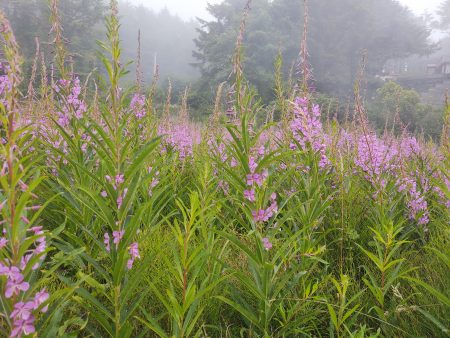
This past week brought a heatwave to Portland, with multiple triple-digit days. We were lucky to get away to the central Oregon coast for part of it, staying in a beach house south of Newport generously offered by Z’s cousins. The misty scene above is the path through a meadow to the cool, foggy beach on the afternoon of our arrival. I was ecstatic.
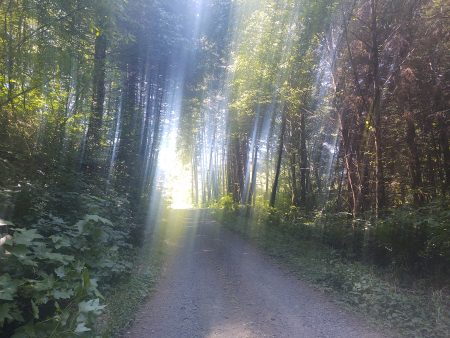
The next day, we drove south along the coast as far as Florence, pausing at many viewpoints and waysides to walk on or just gaze out across the beach. From Waldport we headed inland and up into the hills for an hour or two of forest scenery.
Siuslaw National Forest
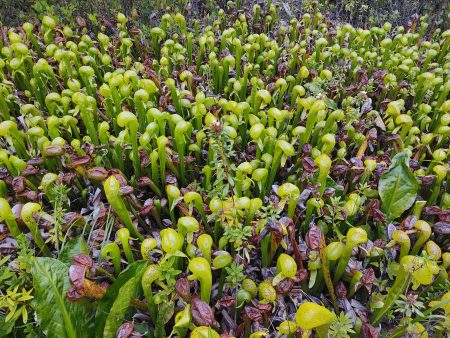
In addition to delicious seafood, good sleep, and air so delightfully cool that I wore a light fleece jacket one evening, the trip included a stop at one of my favorite coastal spots, Darlingtonia Natural Site: a bog packed with insectivorous plants.
It was painful to drive back and see the car’s external temperature indicator rise from 65 at the coast to approximately 9,000,000 when we reached the surface of the Sun–er, the Willamette Valley. But the excursion was a welcome reminder that one of the things I love about living in Portland is that the ocean is only 90 minutes away.
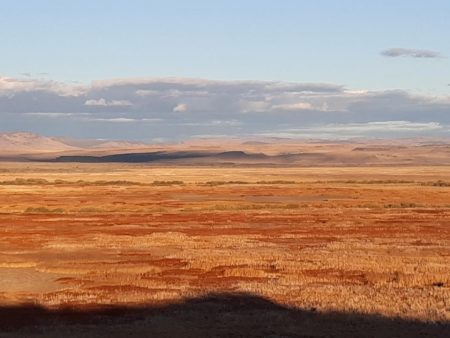
Looking east from Buena Vista, Malheur Wildlife Refuge, the golden hour
A couple of days ago we returned from our fourth road trip of the pandemic. This time we treated ourselves to four days in Oregon’s High Desert, checking out some places that were new to us as well as revisiting an old favorite. It was good to be back in this bold, big-sky part of the state, which always feels expansive and eternal.
Getting a taste of the Warner Valley, the northwest corner of the country’s vast Basin and Range terrain. It’s full of geological wonders we hope to explore when we have more time.
Our first visit to Hart Mountain National Antelope Refuge, where we saw a huge Golden Eagle take off from a clump of lava just feet in front of us, and later drove past wild horses and a herd of pronghorn.
A drive up Steens Mountain at the perfect time of year and day to appreciate the quaking aspen, which were blazingly colorful across swathes of the landscape. At one point we sat for a while between two low-growing clusters of aspen right next to the road: it was like being surrounded by shimmying dancers clad in golden sequins.
Two nights at the Field Station in Malheur Wildlife Refuge: my fourth visit since 2010, Zachary’s second. This setting appears in The Nighthawk’s Evening, an outstanding book about a bird that is less well known than it should be, coming out any day now from OSU Press. The author is scientist Gretchen Newberry, a friend who shared a visit to the Field Station with us in 2011.
The only disappointment was that when we reached Lakeview, we learned that Old Perpetual, Oregon’s only geyser, was inactive due to the low water table in the drought-stricken area. We hope it will be geysering away at its usual 60 feet up, every 90 seconds, the next time we are in that area.
Even though we recently had a fantastic five-day excursion to Crater Lake and Lassen Volcanic National Parks, our lust for road-tripping wasn’t sated. When our cat-sitter again became available for three days and two nights, we loaded up the Outback and headed for Oregon’s magnificent coast, planning to focus on the southern stretch, which we have driven along but never explored.
Our itinerary was perhaps over-ambitious for a three-day round trip from Portland that would be spent largely on the winding Pacific Coast Highway, for we wanted to squeeze in a visit to our favorite redwoods in Jedediah Smith State Park near Crescent City, across the California border. Reader, we did it. The dreaded weekend traffic on the PCH never materialized, the weather was deliciously cool, and we revisited a few old friends, such as Cape Perpetua, and made a lot of new ones. 804 miles well spent. We need to get to the south coast again soon!
Highlights included:
The best fish and chips (albacore tuna) at South Beach near Newport
Lovely beach walks at Seal Rock, Beachside, Bullards, and more, and a few short hikes on the Oregon Coast Trail
A tranquil, fragrant grove of myrtlewood at Humbug Mountain State Park south of Port Orford
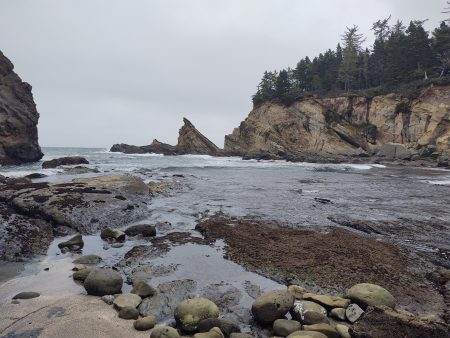
Shore Acres State Park on Cape Arago, with its gorgeous botanical garden and a short walk down to geologically fascinating Simpson Beach, pictured above (hat tip to Wendy Wagner for turning me on to this place)
The windiest walk either of us has ever had, out to the lighthouse on Cape Blanco: sunny, incredibly windy, and glorious
Delicious oyster stew in Bandon
Zachary’s creation of the song title “The Devil You Know and the Six You Don’t” as we drove the Seven Devils Road
Every single wayside, park, and viewpoint in the scenic Samuel Boardman Corridor between Brookings and Gold Beach
The Howland Hill Road and Stout Grove in Jedediah Smith SP
AND we saw a wild bobcat bound across a quiet gravel road!
We got home last evening from our second multi-day excursion of the pandemic era, and it was swell. Among the highlights (details below) were the fulfillment of a lifelong optical-phenomenon goal and the cutest wildlife experience ever.
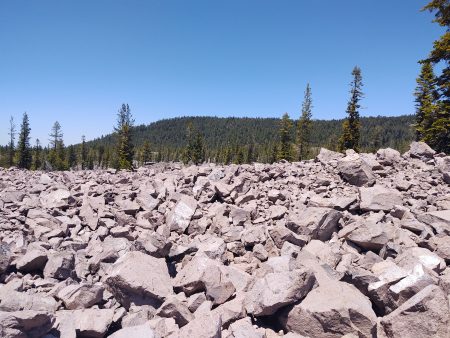
Chaos Jumbles, Lassen NP
Even before the pandemic, it had become a challenge for both Z and me to be away from home at the same time. Our ageing cat, dear Xerxes, gets medicated twice a day and hates to be alone, but alas, a couple of years ago our longtime cat- and house-sitter moved two hours away. She became briefly available last September, so Z and I rolled the Covid dice and chanced a three-night road trip to the Wallowas, which we loved. A few weeks ago we learned that she’d be available again for four nights in June. We jumped on the chance.
We drove south on I-5 to Roseburg and took the North Umpqua Scenic Byway (otherwise known as Hwy 138) to Diamond Lake, just north of Crater Lake. We spent our first night at the DL Resort. On the evening of the second day we drove from Crater Lake National Park southwest to Redding along the Volcanic Legacy Scenic Highway, passing just north of Mt. Shasta. After a night in Redding we hastened to Mt. Lassen Volcanic National Park and spent an entire day there, ending up at Z’s stepsister’s house 90 minutes away. We spent our last two nights there and drove home yesterday, breaking the eight-hour drive with an all-too-brief visit with Z’s cousins in Ashland. Xerxes and our recent addition, Xanthe the Speckled Menace (a young Bengal cat), were in fine fettle when we arrived and seemed barely to have noticed our absence, which speaks well of our sitter.
Highlights:
* Green flash sunset at Crater Lake. We watched a nearly fluorescent sun set behind the rolling hills west of the lake. As the last bit of it sank below the horizon, we saw the green flash. It was yellowish-green, almost chartreuse. I was thrilled. I have long wished to see this phenomenon but even on a long sea cruise never had the luck. So that was pretty damn cool.
* Babies in ground squirrel town. Ground squirrels scampered everywhere around the Diamond Lake Resort. The lawn leading down to the lake had a patch of burrows like a miniature prairie-dog town, with squirrels popping up and down, grazing in the grass, and standing sentry. Then we saw two squirrels bring up their young, who were about as big as my thumb. There were half a dozen of these little ground squirrels altogether. They frolicked and played like puppies, running up a little sand hill and rolling down, piling onto and chasing each other. I didn’t try to use my crappy phone camera because I didn’t want to disturb them.
* Half a dozen good hikes, some of them short but steep. One benign walk took us to the famous Bumpass Hell in Lassen NP.
* Watson Falls, at
293 feet the highest in southwestern Oregon, and Clearwater Falls,
where we saw a lot of American Dippers (sometimes called water
ouzels). These were not my first Dippers, but it was the first time
I’d seen such a close, clear, and protracted display of the bobbing
movement that gives them their name.
* Geological
phenomena at Lassen, including Quenched
Blobs and the Chaos Jumbles. My next band name. . . .
I spent the second half of November in southern Chile, traveling with my partner, Zachary, and two of our friends. We drove up and down the Ruta Panamericana and were based successively in Puerto Varas, Castro (on Chiloe Island), Villarrica, and, for the final two nights, Valdivia.
I loved everything about this part of Chile: the volcanoes, lakes, national parks, and fjords at the gateway to Patagonia; the convivial people; the good seafood and wine. I hope to return someday. Sadly, this trip was marred to some extent by a bad cold passed among the four of us. It didn’t keep us from doing things, but in my case it precluded full energy and enjoyment.
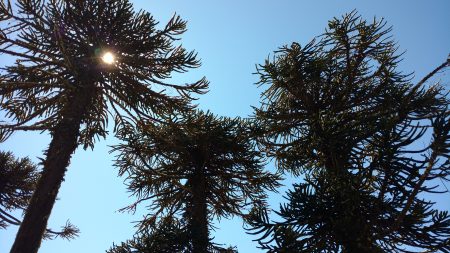
One highlight of the trip was the day I drove us up and up a gorgeous valley, past blue mountain lakes and ever-changing vistas of the line of peaks, to the border with Argentina high in a pass of the Andes. Near there we walked for an hour in the shadow of snowy Volcan Lanin, under a canopy of huge, ancient Araucaria araucana trees. It was glorious. Also, there were penguins on Chiloe–Humboldts and Magellanics. Our first time seeing wild penguins.
I achieved the goal of packing for 16 days of variable weather using carryon luggage: my TLS Motherlode Convertible backpack, with a Rick Steves shoulderbag/daypack as my personal item. Thanks to quick-drying poly knits and performance fabrics, a bit of quick sink laundry every third evening was all it took. As always, though, the binocs and bird guide, chargers and electronics and toiletries, and the spare pair of shoes took up as much space as the clothing.
_5.jpg)