I didn’t hate The Hobbit. I didn’t love The Hobbit. There were bits I enjoyed a lot and bits I found regrettable or even detestable. It was exactly the kind of experience for which “meh” was made. With occasional “feh” and “wow.”
The following comments may include spoilers. But does anybody really not know what’s coming?
Format: My friend Fred and I saw The Hobbit in plain old 2D, 24 fps, so I am unable to weigh in on the Great Frame-Rate Debate. Everything I’ve read suggests that 48 fps could be really, really cool with the right movie, which The Hobbit is very possibly not. James Cameron is purportedly planning for the Avatar sequel to be shown at 60 fps, which could be fabulous. Or not. I confess to a slight residual curiosity about the 48 fps Hobbit, but it is almost certainly too slight to induce me to see the film again. Maybe at one of the $2 second-run theaters I would, but they won’t have the 48 fps projection technology.
Storytelling: My knickers are not particularly twisted by the fact that Jackson & Co. made a film that should really be called Lord of the Rings, Episode I: The Nebulous Menace and not The Hobbit. They went to a lot of trouble to lay the groundwork for what happens in the later trilogy of films, rendering explicit what is implicit in The Hobbit, or is mentioned in that book only obliquely or glancingly, or is elaborated in LotR‘s support structure: the appendices and The Silmarillion. Their goal was to make this movie dovetail neatly with the already-made (and vastly successful) trilogy, and that they did.
That’s fine. It makes sense to spoon-feed backstory and narrative links to audiences who may have seen the LotR films but not read any of the books. It also makes for a longer movie, about which more in a moment.
Appearances in The Hobbit by Frodo, Saruman, and Galadriel–none of whom appear in the book–were okay with me. (I half-expected to see Arwen mooning over a picture of Aragorn in the background, if only to get a second lady-face into the thing.) But although the concept is not bad, the intro in which Bilbo explains to Frodo how Erebor and Dale flourished until Smaug destroyed them is overlong, and Dale looks absurdly like a Renaissance Faire. (In a related gripe, Rivendell, the Last Homely House, looks even more like a Thomas Kinkade-inspired architectural model than ever.)
To make it abundantly clear that Thorin is a Mighty Warrior Prince, the filmmakers flimflam the story of how he survived the dragon’s attack, and here I think the film ventures into the dubious territory of character manipulation.
The most egregious case of this is Bilbo. Martin Freeman is terrific as Bilbo–the best thing about this movie. Inspired casting, fine acting. But the tension between Bilbo and Thorin feels forced and manipulative, as though “Look, we’ve given these characters a powerful arc” were written in glowing Elvish script above each of their scenes. Near the end of this installment Bilbo is thrust into a bit of battlefield derring-do that I found utterly unconvincing. His transformation from timid hobbit to Sting-wielding warrior comes much too soon and is too extreme. If, in the third movie, we see Bilbo hewing and hacking instead of spending most of the Battle of the Five Armies unconscious, I will be disappointed but not surprised.
Good, Bad, and Ugly: I loved the encounter and riddle game between Bilbo and Gollum. Andy Serkis is even more Gollumy, more simultaneously horrible and pitiful, than before. I hated the preposterously long, over-the-top sequence in which Gandalf and the dwarves escape from the Goblin King’s caves. More hokey than every runaway-mine-cart-on-shaky-trestles scene you’ve ever seen, it resembles nothing so much as the inevitable madcap chase scene in a Scooby-Doo episode. I half expected Gandalf to throw Bombur a Scooby Snack when it was over.
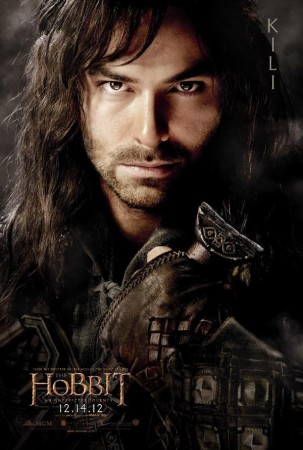
And Radagast . . . in the name of all that is good and decent, what have they done to Radagast? He always sounded like a cool character, and I was delighted to hear that he would appear onscreen in The Hobbit. How hollow that delight seems now that my eyeballs have been blasted with things I can’t unsee. Radagast and the fart jokes–who wrote this thing, frat boys? But speaking of how characters look, is it creepy that I thought Kili was totally hot?
Length: Normally I loves me a 3-hour movie, especially if it’s sf or fantasy and full of big effects and cool stuff to look at. I like to settle in knowing that the delights and excitement unfolding before me will continue for a while. During this movie I would’ve looked at my watch, except that I don’t wear a watch these days and was too polite to turn on my phone to check the time. There was a lot of running around and a lot of orc-hewing, and you know, it’s all kind of the same. A little goes a long way, but “a little” seems a concept foreign to this franchise.
In fairness, we had sat through a lot of junk before the movie even started. On the plus side, though, how cool is it that five of the trailers were for sf, fantasy, or horror films? Well, horror-comedy. I refer to Pacific Rim (looks very Lovecraftian in some ways), After Earth, Oblivion, Epic, and Warm Bodies.
I loved Jackson’s LotR movies, even when I had gripes about details or minor elements. I watch them from time to time on Blu-Ray. I know I’ll go to see the second and third installments of The Hobbit, but they will have to be better than this one for me to want to own them, or even to watch them twice.